

Cost of Waiting
BACK TO PAGE

The Real Cost of Waiting

Lee Malbeuf

August 2026

Why Investing in Solar Today Could Save You Thousands Tomorrow

If you've lived in British Columbia for any length of time, you've probably noticed that your BC Hydro bill isn't quite what it used to be. While BC continues to enjoy some of the lowest electricity rates in North America, those rates haven't stood still—and they aren't expected to stay the same forever. [BC Hydro]

For homeowners and businesses considering solar, it's worth looking beyond today's rates and asking a more important question:

What will electricity cost over the next 25 to 30 years?

After all, that's the lifespan of a quality solar energy system.

Increasing Electricity Rates

Customers saw a 3.75% net bill increase effective April 1 by BC Hydro; continuing a pattern of gradual annual adjustments.  Every increase, even a modest one, compounds over time.

Electricity rates aren't increasing simply because electricity costs more to produce.

BC Hydro is investing $36 billion in planned capital investment over 10 years: [BC Hydro]

  • Modernizing aging infrastructure 
  • Expanding transmission lines 
  • Supporting rapid population growth 
  • Building new renewable energy projects 
  • Meeting increasing demand from electric vehicles, heat pumps, and industrial electrification 
  • Improving grid reliability and cybersecurity 

These investments help ensure British Columbia has reliable, clean electricity for decades to come—but they also require continued investment, which is reflected in future electricity rates. 

A few percent each year may not sound significant. But over the lifetime of a solar system, those increases can have a surprisingly large impact.

Consider this simple example:

Using two households with the same annual electricity consumption of 10,000 kWh, let’s compare the potential costs over time—one purchasing all of its electricity from the grid and the other with an 8 kW solar system producing approximately 8,000 kWh per year. This example assumes electricity prices increase by an average of 3% annually.
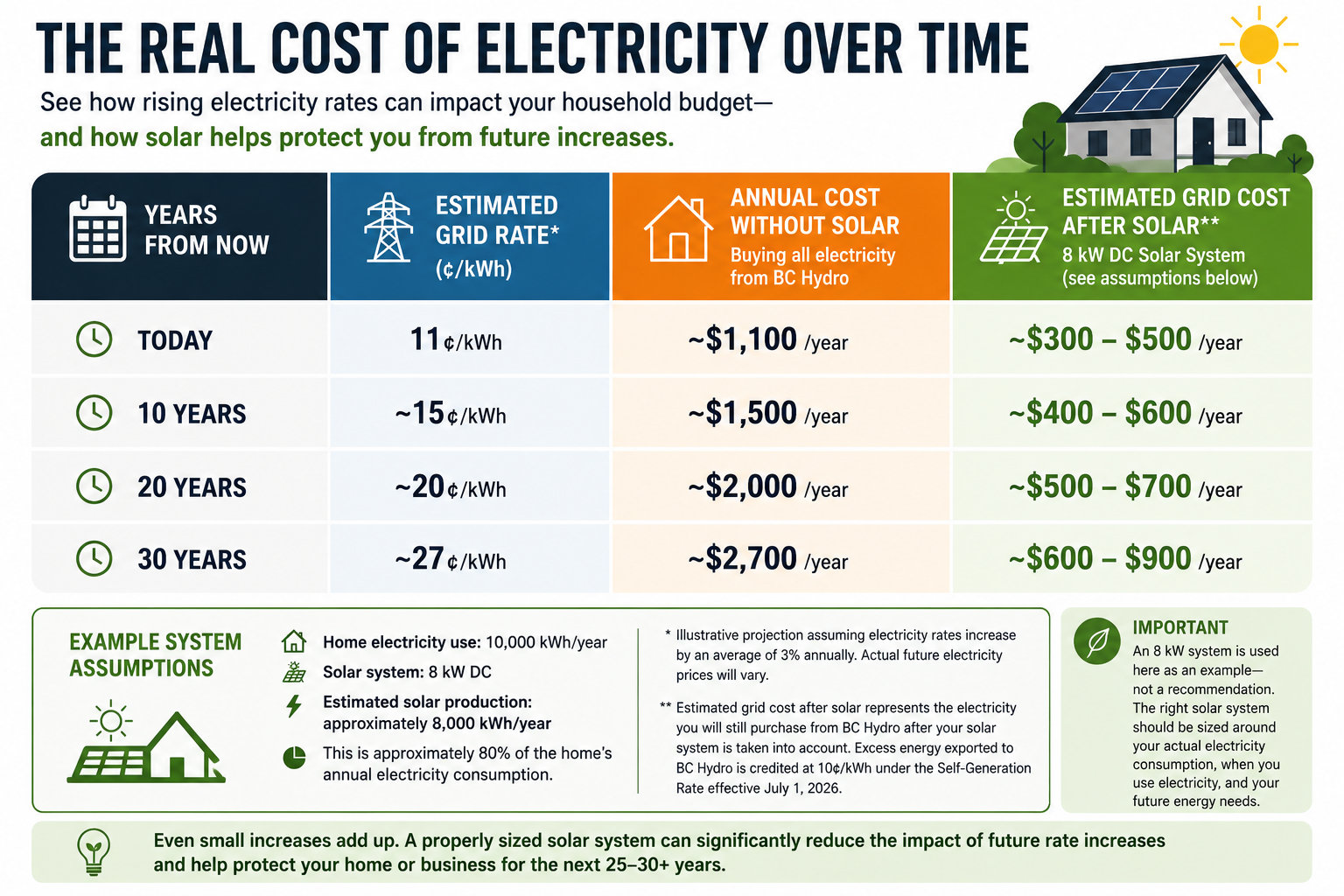
Infographic comparing projected electricity costs with and without solar over 30 years. Based on a home using 10,000 kWh per year and an 8 kW DC solar system producing approximately 8,000 kWh annually, the graphic shows estimated grid rates increasing from 11¢/kWh today to approximately 27¢/kWh in 30 years. Annual electricity costs without solar are projected to rise from about $1,100 to $2,700, while estimated remaining grid costs with solar range from $300–$500 today to $600–$900 in 30 years. Projections assume a 3% annual electricity rate increase.
[BC Hydro]

The difference becomes even more significant when you look at the cost over decades. A home that continues purchasing all of its electricity from the grid could see its annual electricity costs increase substantially as rates rise. A properly sized solar system, on the other hand, can generate a significant portion of that electricity on-site, reducing the amount of power that needs to be purchased from the grid. While solar doesn't eliminate your electricity bill, it can help protect your household or business from the impact of future rate increases for the 25–30+ year life of the system.

Solar Helps Lock In Your Energy Costs

Most homeowners think about solar as a way to lower their monthly hydro bill. While that's certainly true, many people overlook another major benefit:

Solar provides protection against future electricity price increases.

Once your solar system is installed, every kilowatt-hour it produces is one you don't need to purchase from the grid. Whether electricity costs increase by 2%, 3%, or even more over the coming decades, your solar panels continue producing clean energy from the sun.

Since quality solar panels are designed to last 25 to 30 years—and often last much longer—you can enjoy decades of predictable energy production.

Instead of wondering what BC Hydro rates might look like in 2040 or 2055, you're generating much of your own power every sunny day.

Businesses Benefit Even More

For commercial buildings, electricity is often one of the largest ongoing operating expenses.

Solar helps businesses:

  • Reduce long-term operating costs 
  • Improve budget certainty 
  • Potentially enhance property value and marketability
  • Demonstrate environmental leadership 
  • Take advantage of available tax incentives and rebates where applicable 

Every dollar not spent on electricity is a dollar that can be invested back into your business.

Solar Is About More Than What You Generate—It’s About What You Use

With BC Hydro’s new Self-Generation Rate taking effect July 1, 2026, how your solar system is designed matters more than ever. Under the new Rate Schedule 2289, electricity your solar system produces is used by your home or business first. If your system generates more electricity than you need at that time, the excess can be exported to the BC Hydro grid, where it earns a 10¢/kWh bill credit. [BC Hydro]

That makes self-consumption an important part of maximizing the value of your solar investment. For example, if your panels produce electricity while you're using appliances, running equipment, charging an EV or operating your business, that solar power can directly offset electricity you would otherwise purchase from BC Hydro at your applicable electricity rate. Excess electricity that isn't used on-site is instead exported and credited at 10¢/kWh.

This is why bigger isn't always better when it comes to solar. A properly designed system should be sized around your actual electricity consumption, usage patterns and future energy needs—not simply the maximum number of panels that can fit on your roof.

At Riverside Energy Systems, we look at how and when you use electricity to help design a system that prioritizes on-site energy use and makes the most of every single watt your solar array produces.

The goal isn't just to generate more solar energy. It's to get the most value from the energy you generate.

What Does Waiting Actually Cost You?

No one can predict exactly what electricity prices will be 10, 20, or 30 years from now.

What we do know is:

  • Electricity demand across BC continues to grow.  [BC Hydro]
  • Infrastructure investments are ongoing. 
  • BC Hydro has already announced additional approved rate increases. 
  • Solar technology has never been more efficient or affordable than it is today. 

So what could solar look like for your home or business?

You don’t have to guess.

Use your actual BC Hydro bill with the Riverside Energy Solar Calculator to get a personalized estimate of your potential solar production, energy savings and system size. By using your own electricity usage, you can see how solar could fit your specific energy needs rather than relying on a generic example.

Put Your Own Numbers to the Test

Grab your latest BC Hydro bill and see what solar could do for you.

Try the Riverside Solar Calculator →

The longer you wait, the more electricity you continue purchasing from the grid. Find out what solar could save you—and start planning for the next 25–30 years of energy costs today.

TESTIMONIAL
Request a Quote
What type of system are you looking for?*
Submit
Oops! Something went wrong while submitting the form.
Cost of Waiting
BACK TO PAGE

The Real Cost of Waiting

August 2026

Why Investing in Solar Today Could Save You Thousands Tomorrow

If you've lived in British Columbia for any length of time, you've probably noticed that your BC Hydro bill isn't quite what it used to be. While BC continues to enjoy some of the lowest electricity rates in North America, those rates haven't stood still—and they aren't expected to stay the same forever. [BC Hydro]

For homeowners and businesses considering solar, it's worth looking beyond today's rates and asking a more important question:

What will electricity cost over the next 25 to 30 years?

After all, that's the lifespan of a quality solar energy system.

Increasing Electricity Rates

Customers saw a 3.75% net bill increase effective April 1 by BC Hydro; continuing a pattern of gradual annual adjustments.  Every increase, even a modest one, compounds over time.

Electricity rates aren't increasing simply because electricity costs more to produce.

BC Hydro is investing $36 billion in planned capital investment over 10 years: [BC Hydro]

  • Modernizing aging infrastructure 
  • Expanding transmission lines 
  • Supporting rapid population growth 
  • Building new renewable energy projects 
  • Meeting increasing demand from electric vehicles, heat pumps, and industrial electrification 
  • Improving grid reliability and cybersecurity 

These investments help ensure British Columbia has reliable, clean electricity for decades to come—but they also require continued investment, which is reflected in future electricity rates. 

A few percent each year may not sound significant. But over the lifetime of a solar system, those increases can have a surprisingly large impact.

Consider this simple example:

Using two households with the same annual electricity consumption of 10,000 kWh, let’s compare the potential costs over time—one purchasing all of its electricity from the grid and the other with an 8 kW solar system producing approximately 8,000 kWh per year. This example assumes electricity prices increase by an average of 3% annually.

Infographic comparing projected electricity costs with and without solar over 30 years. Based on a home using 10,000 kWh per year and an 8 kW DC solar system producing approximately 8,000 kWh annually, the graphic shows estimated grid rates increasing from 11¢/kWh today to approximately 27¢/kWh in 30 years. Annual electricity costs without solar are projected to rise from about $1,100 to $2,700, while estimated remaining grid costs with solar range from $300–$500 today to $600–$900 in 30 years. Projections assume a 3% annual electricity rate increase.
[BC Hydro]

The difference becomes even more significant when you look at the cost over decades. A home that continues purchasing all of its electricity from the grid could see its annual electricity costs increase substantially as rates rise. A properly sized solar system, on the other hand, can generate a significant portion of that electricity on-site, reducing the amount of power that needs to be purchased from the grid. While solar doesn't eliminate your electricity bill, it can help protect your household or business from the impact of future rate increases for the 25–30+ year life of the system.

Solar Helps Lock In Your Energy Costs

Most homeowners think about solar as a way to lower their monthly hydro bill. While that's certainly true, many people overlook another major benefit:

Solar provides protection against future electricity price increases.

Once your solar system is installed, every kilowatt-hour it produces is one you don't need to purchase from the grid. Whether electricity costs increase by 2%, 3%, or even more over the coming decades, your solar panels continue producing clean energy from the sun.

Since quality solar panels are designed to last 25 to 30 years—and often last much longer—you can enjoy decades of predictable energy production.

Instead of wondering what BC Hydro rates might look like in 2040 or 2055, you're generating much of your own power every sunny day.

Businesses Benefit Even More

For commercial buildings, electricity is often one of the largest ongoing operating expenses.

Solar helps businesses:

  • Reduce long-term operating costs 
  • Improve budget certainty 
  • Potentially enhance property value and marketability
  • Demonstrate environmental leadership 
  • Take advantage of available tax incentives and rebates where applicable 

Every dollar not spent on electricity is a dollar that can be invested back into your business.

Solar Is About More Than What You Generate—It’s About What You Use

With BC Hydro’s new Self-Generation Rate taking effect July 1, 2026, how your solar system is designed matters more than ever. Under the new Rate Schedule 2289, electricity your solar system produces is used by your home or business first. If your system generates more electricity than you need at that time, the excess can be exported to the BC Hydro grid, where it earns a 10¢/kWh bill credit. [BC Hydro]

That makes self-consumption an important part of maximizing the value of your solar investment. For example, if your panels produce electricity while you're using appliances, running equipment, charging an EV or operating your business, that solar power can directly offset electricity you would otherwise purchase from BC Hydro at your applicable electricity rate. Excess electricity that isn't used on-site is instead exported and credited at 10¢/kWh.

This is why bigger isn't always better when it comes to solar. A properly designed system should be sized around your actual electricity consumption, usage patterns and future energy needs—not simply the maximum number of panels that can fit on your roof.

At Riverside Energy Systems, we look at how and when you use electricity to help design a system that prioritizes on-site energy use and makes the most of every single watt your solar array produces.

The goal isn't just to generate more solar energy. It's to get the most value from the energy you generate.

What Does Waiting Actually Cost You?

No one can predict exactly what electricity prices will be 10, 20, or 30 years from now.

What we do know is:

  • Electricity demand across BC continues to grow.  [BC Hydro]
  • Infrastructure investments are ongoing. 
  • BC Hydro has already announced additional approved rate increases. 
  • Solar technology has never been more efficient or affordable than it is today. 

So what could solar look like for your home or business?

You don’t have to guess.

Use your actual BC Hydro bill with the Riverside Energy Solar Calculator to get a personalized estimate of your potential solar production, energy savings and system size. By using your own electricity usage, you can see how solar could fit your specific energy needs rather than relying on a generic example.

Put Your Own Numbers to the Test

Grab your latest BC Hydro bill and see what solar could do for you.

Try the Riverside Solar Calculator →

The longer you wait, the more electricity you continue purchasing from the grid. Find out what solar could save you—and start planning for the next 25–30 years of energy costs today.

Button Text -->